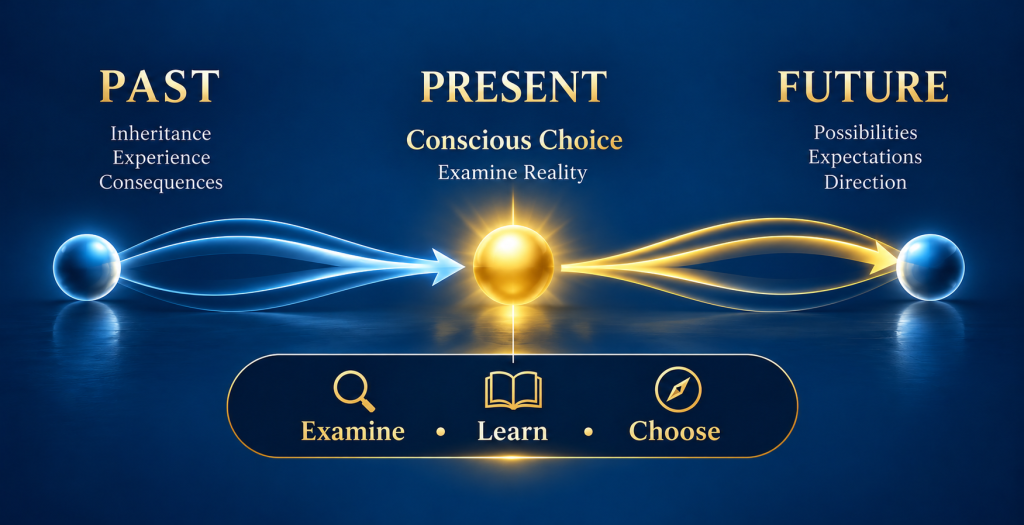
More Questions Than Answers
The world gives us more questions than answers.
I am no different.
I have more questions than answers.
Perhaps the important thing is not to have an answer for everything, but to learn how to look more deeply at the questions in front of us.
Here is one of them:
Some things appear stable.
Others are clearly moving and changing.
But look a little closer.
Even what appears stable is changing.
A tree stands in the same place, yet life is moving within it. We remain ourselves, yet our thoughts, relationships and circumstances change. Societies preserve familiar structures while something new may already be developing beneath them.
Perhaps stability and movement are not simply opposites.
Stability gives us form, continuity and boundaries. Movement takes place within those boundaries—and sometimes begins to press against them.

Stability · Movement

This raises an interesting question.
When a boundary no longer fits changing reality, should we preserve it, adapt it, or move beyond it?
Beyond the limits means moving from one set of limits into a new one.
Sometimes the seed of what comes next is already growing within the present.
And when conditions and purpose call for movement, we SHIFT.
The Person Behind SHIFT

My name is Haile Ghebru. I grew up in Eritrea and now live in Australia.
The ideas you’ll find here were not born in a classroom. They were tested by life.
My journey has taken me through armed struggle, political activism, political imprisonment, exile, and building a new life and business in a new country.
For many years, I believed deeply in one philosophy. It shaped how I saw the world and what I fought for.
Then history challenged it.
Slowly, I began to see its limits. And I faced a choice: hold on to what I had always believed, or examine what might lie beyond its limits.
I chose to look beyond.
Over time, that journey led to SHIFT.
I bring my experience. You bring yours.
Let’s see what we discover together.
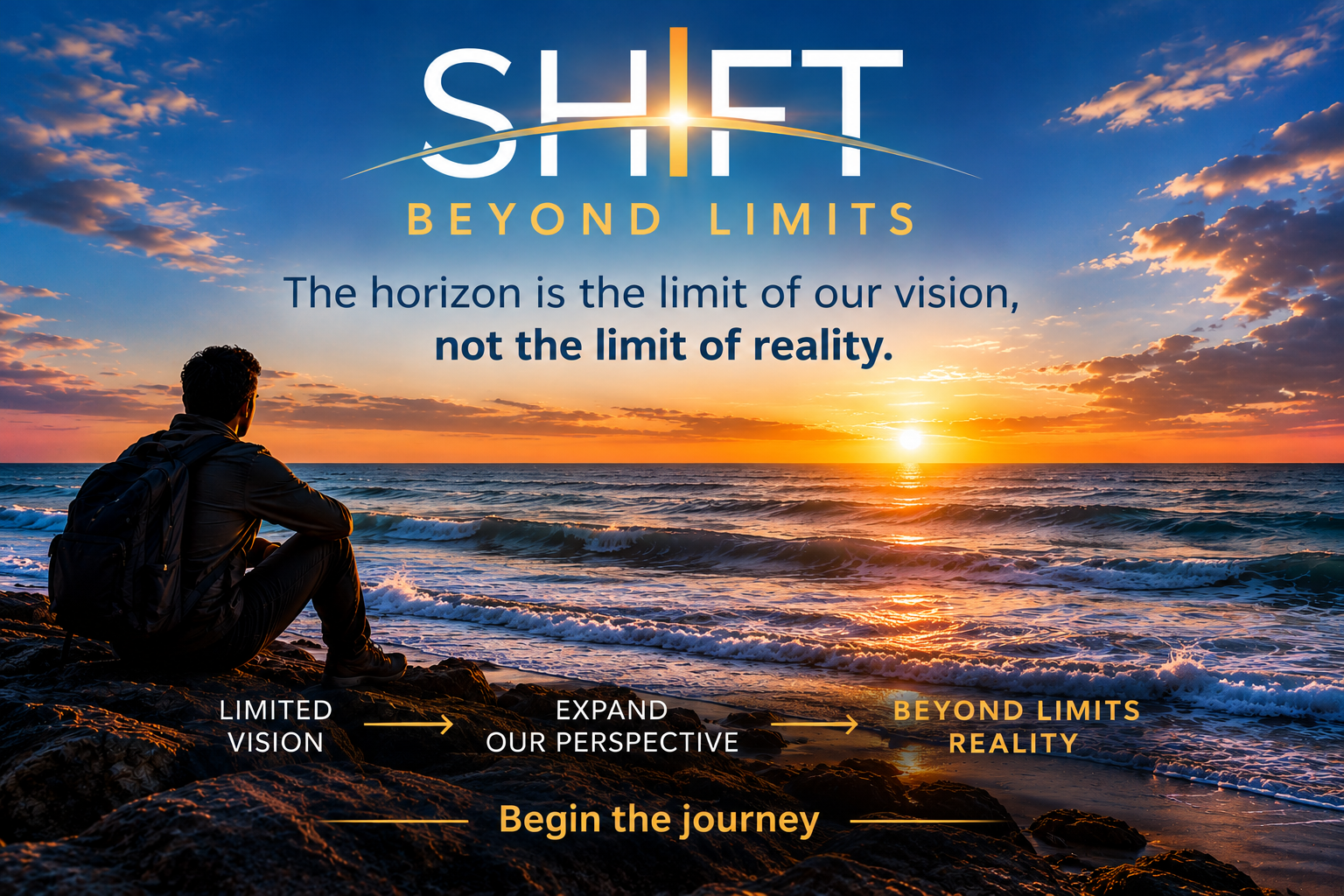
SHIFT — Beyond the Limits
The Light That Led to SHIFT
I felt that I had found a light—my own light.
But they did.
That experience taught me something important: another person cannot become your light. But sometimes we can help one another discover and strengthen our own light.
And if our individual lights begin to meet, perhaps together we can illuminate something larger.
My journey is mine. Yours will be different.
Discover your light. Strengthen your light. Then see where it can reach.
Light,Not Noise

I was loud.
I was part of the noise.
But somewhere along my journey, I realized that I had lost my voice within it.
Something changed
I SHIFTED.
I no longer want to be part of the noise.
That does not mean becoming silent.
SHIFT has a voice.
But not a voice that competes merely to be louder.
Not a voice that turns every disagreement into an argument, every argument into a contest, and every contest into victory or defeat.
I want a different kind of voice—
a voice that looks inward and outward;
that sees structures but also recognizes movement and change;
that looks beyond what appears fixed toward possibility and creativity.
A voice that seeks to illuminate rather than defeat.
I choose light.
I do not want to tell you what to think.
I want to show you some of the light I have discovered.
Then the choice is yours.
If you choose to strengthen your own light, let it be your light—not mine, and not someone else’s.
Let your light illuminate you.
Let it reach the person beside you.
My light can meet your light.
Your light can meet another.
And gradually, the light of individuals can become the light of a neighborhood, a community, and something larger.
Not larger noise. Larger light.
That is the direction.
That is the hope.
And that is part of the mission of SHIFT — Beyond the Limits.
Introduction · 3 of 3
Moving Beyond the Limits
SHIFT is a movement toward change and transformation.
Beyond the Limits does not mean without limits.
Some limits restrict what may be possible.
Some limits protect what we value.
Wisdom is learning to recognize the difference.
We seek the freedom to explore, question, imagine, and move toward possibilities beyond what we already know.
But freedom does not mean recklessness.
Movement needs awareness.
Choice carries responsibility.
And transformation needs purpose.
SHIFT does not ask everyone to move in the same way.
Part One
See Differently
A
The Starting Point
SHIFT
Beyond the Limits
Sometimes the limit is the way we are looking.
Look again.
Change the perspective.
Discover another possibility.
Is it time to SHIFT?
Explore SHIFT
B
Part One · B
What Is SHIFT?
We all develop familiar ways of seeing, thinking, and responding to life. They help us navigate the world—but sometimes they can also limit what we see.
SHIFT is about becoming aware of those limits.
t is the ability to pause, look again, change perspective when necessary, and discover possibilities we may not have seen before.
SHIFT does not mean changing everything.
Sometimes we need to change.
Sometimes we need to remain steady.
The important thing is to recognize the difference—and choose consciously.
SHIFT begins with awareness.
C
Part One · C
Where Might You Need to SHIFT?
A problem.
A decision.
A relationship.
A goal.
A possibility you have stopped considering.
Am I seeing the situation as it really is—or only as I have become accustomed to seeing it?
What if I looked again?
What if I changed the perspective?
What might I notice that I could not see before?
You do not have to change your decision.
You do not have to abandon what you believe.
Sometimes looking again confirms that you should remain exactly where you are.
But sometimes…
you discover another possibility.
That is the beginning of SHIFT.
D
How Do You SHIFT?
Pause. Look again. Ask another question.
When you feel stuck, do not immediately push harder in the same direction.
Pause.
Ask yourself:
What might I be missing?
Is there another way to see this?
Has the situation changed while my thinking remained the same?
What should I keep—and what might I need to change?
Then consider another possibility before you decide.
You may return to your original answer with greater confidence.
Or you may discover a direction you had not seen before.
The purpose is not to change your mind every time.
The purpose is to make sure your mind is still free to change when there is a reason to.
Pause. Look again. Choose consciously.
E
One Perspective Is Rarely the Whole Picture
We all see life from somewhere.
Our experiences, knowledge, beliefs, emotions, and circumstances shape what we notice—and sometimes what we miss.
That does not make our perspective useless
It simply means it may not be complete.
When something matters, try moving around it mentally.
Look from another angle.
Look from the opposite.
Ask a different question.
Listen to another point of view.
Notice what changes—and what remains.
You may discover that your original view was right.
You may discover that it was only partly right.
Or you may see something you could not see before.
The goal is not to lose your point of view.
It is to avoid becoming trapped inside it.
See from where you stand. SHIFT. Then see from somewhere else.
F
See More. Then Decide.
a wider view.
Hold the different perspectives in front of you.
What does each one reveal?
What does each one miss?
Where do they agree?
Where do they differ?
What changes when you move from one to the other?
Then return to yourself.
Reflect.
See more.
Understand more.
Shift.
Then choose consciously.
G
Part One · G
When the Situation Changes
A good decision today may not remain the right decision forever.
Life moves.
Circumstances change.
New information appears.
You change too.
Something that once helped you may begin to limit you.
Something that once seemed impossible may become possible.
And something that once required change may later require stability.
So do not ask only:
Was this the right decision?
Ask again:
Is it still the right decision now?
Pay attention to what is changing around you—and within you.
Do not change simply because time has passed.
And do not remain simply because something has worked before.
Look again.
Understand the new situation.
Then decide what should remain and what should change.
When reality moves, let your thinking remain awake.
H
Know Why You Are Moving
Recognizing the need for change is important.
But change alone does not tell you where to go.
You can move quickly in the wrong direction.
You can break a boundary and discover that it was protecting something valuable.
You can leave the familiar without knowing what you are moving toward.
So before you SHIFT, ask:
Why am I moving?
What am I trying to achieve?
What should I protect along the way?
Where do I want this change to take me?
Purpose gives direction to movement.
Sometimes purpose tells you to move.
Sometimes it tells you to slow down.
Sometimes it tells you to remain where you are.
And sometimes it tells you that the direction itself must change.
Do not SHIFT for the sake of shifting.
Know why you are moving. Then move with purpose.
I
See the Person Across from You
You are not the only person looking at the situation.
Someone else may be standing somewhere you are not.
They may have different experiences.
Different information.
Different fears.
Different hopes.
And from where they stand, the same situation may look very different.
Before deciding that they simply do not understand—
SHIFT.
Try to see what they can see from where they stand.
Understanding another person’s perspective does not mean surrendering your own.
It does not mean that every position is equally right.
It means giving yourself the opportunity to listen and understand before you judge.
And sometimes, when two people stop defending only where they stand, they discover something neither could see alone.
See the person. See their position. SHIFT the perspective. Then begin the conversation.
J
Make Room for Conversation
A conversation is more than two people waiting for their turn to speak.
If you enter only to defend your position, you may hear the words of the other person without really listening.
If you enter only to win, every difference can begin to look like a battle.
SHIFT creates another possibility.
Bring your perspective.
Listen to theirs.
Ask questions.
Look for what you may have misunderstood.
Look for what they may not yet see.
And leave enough space for both of you to discover something new.
You may still disagree.
Some differences are real.
Some cannot be resolved immediately.
But disagreement does not have to end the conversation.
Sometimes the purpose of conversation is not to make one person defeat the other.
It is to understand the difference clearly enough to discover what becomes possible next.
Do not enter every conversation asking:How can I win?
Sometimes ask: What can we discover?
K
Find What You Can Build Together
Understanding each other does not require becoming the same.
You may still see things differently.
You may disagree about important questions.
But difference does not always have to become division.
Sometimes, beneath the disagreement, there is something both people value.
A problem both want to solve.
A future both want to improve.
A possibility neither can create alone.
Look for that space.
Ask:
Where do our interests meet?
What do we both care about?
What becomes possible if we work together?
Do not wait for complete agreement before discovering common ground.
Sometimes cooperation begins with one small thing two people can do together.
And through working together, they may begin to understand each other differently.
See the difference. Find the common ground. Build what neither could build alone.
L
Become Part of Something Larger
What begins between two people does not have to end there.
A shared idea can invite another person.
A small act can encourage another.
A solution can become something others improve.
And gradually, individual effort can become shared effort.
Community does not begin somewhere outside us.
It begins when people recognize their common interests and when they believe that some things are better built together.
You do not have to solve every problem.
You do not have to carry every responsibility.
But you can ask:
What can I contribute?
What do I know?
What can I learn?
Where can I help?
Who can I work with?
Your contribution may be small.
Purpose gives direction to movement.
But when it meets the contributions of others, something larger can begin to grow.
Bring what you can. Learn from what others bring. Build something larger together.
M
Part One · M
SHIFT the Focus to Yourself
You have looked beyond where you first stood.
You have seen from another perspective.
You have listened.
You have questioned.
You have made choices.
You have experienced change.
You have met another person across the difference.
You have discovered what conversation can open.
And you have begun to see what people can build together.
Now SHIFT the focus to yourself.
Reflect.
What have you learned?
What have you changed your mind about?
What do you understand differently?
What remains important to you?
What have you discovered about yourself?
Do not simply confirm the person you were when you began.
Bring the journey with you.
Let experience speak to your thinking.
Let what you have learned become part of how you see and how you live.
And then look again.
You are looking at yourself again—
but you are not looking from exactly the same place.
Reflect. Learn. Renew. Then begin again.